
Car Talk at Port of Hueneme
We usually think of fruits and vegetables when we think of the Port of Hueneme. After all, it refers to itself as the “Port That Farmers Built”, and it has long been a primary conduit for fresh banana imports from Central America. But, as the largest deepwater port along California’s coast between Los Angeles and San Francisco, it has come to deal in an increasingly diverse array of imports and exports. (Lately, for example, its most valuable export was the $191 million in helicopters that were shipped to South Korea last year.)
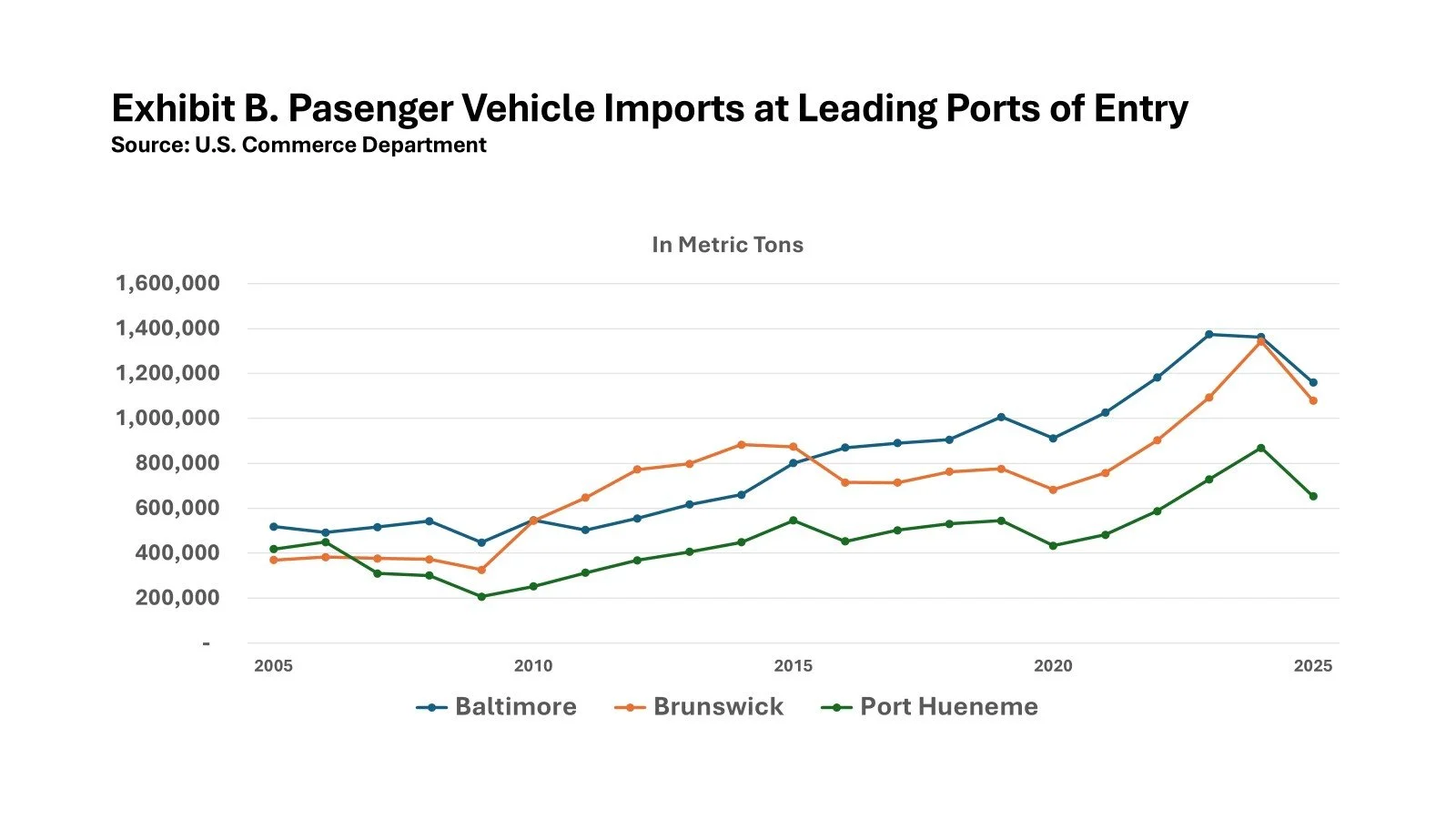
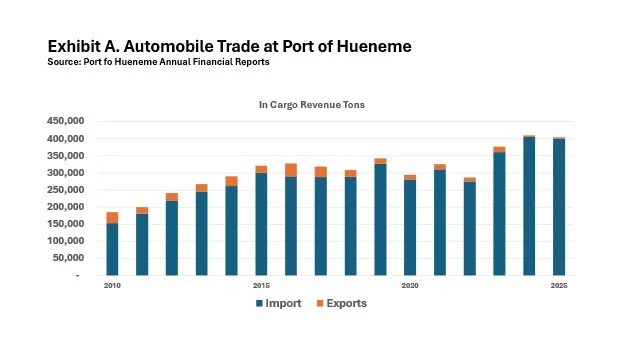
Port Hueneme has also served as one of the nation’s major ports-of-entry for motor vehicle imports. In 2025, it ranked only behind Baltimore and Georgia’s Port of Brunswick as an importer of cars and other motor vehicles used to transport people. Last year, the port handled 8.3% of the $125.517 billion U.S. import trade in motor vehicles used to transport people. Even though the port’s share of America’s motor vehicle import trade slipped in the past year from 7.0% in 2024 to 6.0% in 2025, it still ranked as the nation’s sixth largest importer by dollar value of cars, trucks, and specialty vehicles.
Exhibit B displays the close competition over the past two decades between the Ports of Baltimore, Brunswick, and Port Hueneme for shares of U.S. imports of passenger vehicles.
Electric Vehicles (EV) Exports
It was not too long ago that Tesla served its overseas customers by shipping its electric passenger vehicles from its assembly plant in Fremont, California through the nearby Port of San Francisco. But, as Tesla began building other assembly facilities here and abroad, that trade shifted to other ports. In 2020, when Tesla accounted for an estimated eighty percent of all of the electric vehicles manufactured in the United States, U.S. trade statistics show that 91.6% of America’s $4.975 billion EV export trade that year was conducted through the Port of SF, up from 84.7% the previous year. The Bay Area port’s share remained high the next year at 90.8% before plummeting steadily to only 6.4% last year. In that year, two other U.S. maritime gateways held higher shares of the EV export trade, Georgia’s Port of Brunswick (37.9%) and the Port of Charleston (35.1%).