
Northern California features two riparian ports that serve the region’s agricultural and construction industries. The Port of West Sacramento (until 2008, the Port of Sacramento) is located in Yolo County, some 79 nautical miles from San Francisco. It has access to Suisun Bay via the 40-mile Deep Water Ship Channel (DWSC) and not via the Sacramento River. The Sacramento DWSC was completed in 1963. The channel is maintained at a depth of 30 feet by the United States Army Corps of Engineers. The Sacramento DWSC lies within Solano, Sacramento, and Yolo Counties, and extends for 43 miles from Collinsville to the city of West Sacramento. The lower portion of the channel follows the natural channel of the Sacramento River and Cache Slough; the upper portion is manmade, extending overland to terminate at the Port of West Sacramento. The Port of West Sacramento facilities include a harbor and turning basin. The Sacramento DWSC varies in width from 200 to 400 feet. The turning basin at the Port of Sacramento is triangularly shaped, being 3,100 feet long and 1,800 feet wide at the widest point. Plans to deepen and widen the channel have been authorized, but funding has not been allocated.
Throughout its 79 year history, the port has served the agricultural, natural resources, and construction sectors in Northern California. The port operates as a break-bulk and bulk facility rather than handling shipping containers (which are primarily shipped out of the Port of Oakland). Rice, for example, is loaded directly onto bulk carriers as bagged or bulk grain. Today, the Port’s primary cargos are rice (exports) and cement (imports).
Over on the San Joaquin River, the Port of Stockton also supports the agricultural economy of the Central Valley, arguably the most valuable piece of agricultural real estate on the planet and the heart of California’s $65 billion agricultural economy, by far the largest in the nation. Virtually all of the 1,613,685 metric tons of commodities valued at $744.3 million imported through the port last year were in support of the region’s growers and food processors. On the export side, the Port of Stockton handled 824,340 metric tons of bulk cargo, rice constituting 41.8% of the port’s total exports that year. Work on the Stockton DWSC began in 1928. It lies within Contra Costa and San Joaquin Counties, and extends for 41 miles within the San Joaquin River from the upstream end of New York Slough near Antioch to the City of Stockton. The Stockton DWSC varies in width from 200 to 600 feet, except in the turning basin at the Port of Stockton where it is 970 feet wide.
In addition to its more recent role supporting the region’s growers, the Port of Stockton was a major cog in the supply chains linking American industry with the nation’s armed forces throughout the Pacific during World War Two. Indeed, today’s Port facilities include Rough & Ready Island, a former Navy Supply Depot.
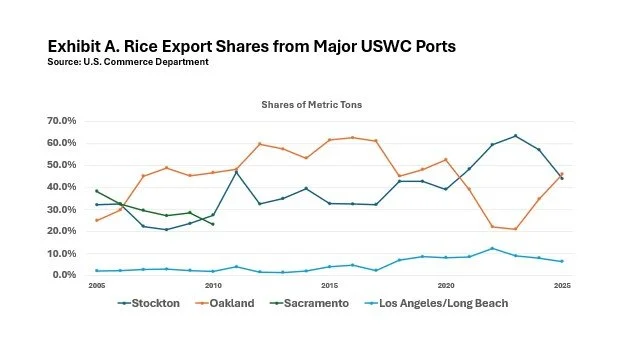
The Mystery of the Rice Trade. Of the two ports, which handles more of California’s rice exports? That’s hard to tell. The U.S. Government stopped reporting data on international trade through the Port of West Sacramento in 2010. That’s unfortunate. In that year, the port accounted for 23.2% of the 990,946 metric tons of rice shipped abroad from USWC ports, as Exhibit A indicates.
But the Port of West Sacramento did not suddenly stop shipping rice that year. How much rice has continued to be exported through the port is a figure not routinely shared by the Port of West Sacramento or by the region’s rice shippers. A fairly recent Instagram posting by the port claimed that it had exported “more than 450,000 metric tons of rice” in 2023 and 2024. If accurate, that would represent about 36% of the 1.216 million metric tons of rice the U.S. Commerce Department believes were shipped abroad through all USWC ports in those two years. Or would it add 450,000 tons to the total reported by the Feds? The answer is not immediately clear.
Go figure.