
Bridging the Needs of the Present and the Future
By Gene Seroka, Executive Director, Port of Los Angeles
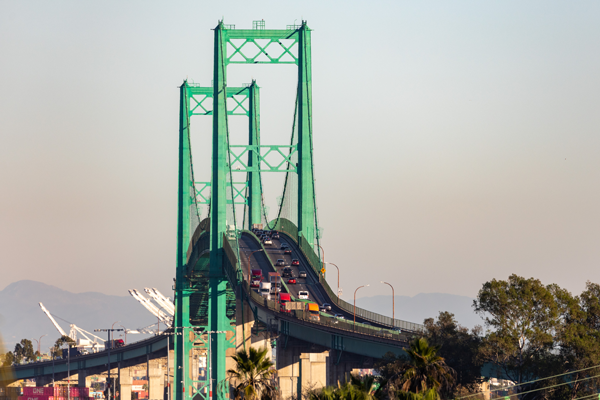
The Vincent Thomas Bridge is more than a landmark on the San Pedro skyline; it is the front door to the American economy. For decades, this bridge has been a silent partner in the grit and hustle of every longshore worker and trucker in San Pedro Bay. We all share a profound pride in this Port’s identity as the busiest container port in the Western Hemisphere, and we know that our gateway is only as strong as the infrastructure supporting it. Today, the bridge presents a dual challenge: the urgent need to address its safety and reliability; and the fact that it is too low to allow modern container vessels to pass underneath it.
We need to address both problems.
Starting in November, we face a mandatory transition. Caltrans will begin a vital 16-month project to replace the entire deck of the Vincent Thomas Bridge. This is a necessity, not a choice. Recent inspections saw the bridge's rating drop from "good" to "poor," making this work essential for the safety of the more than 53,000 commuters and truck drivers who cross it daily.
Major construction is a normal activity at the Port of Los Angeles, but the bridge requires unique planning and preparation. While only about 8% of the bridge traffic are trucks moving port cargo, we recognize that for a driver, every minute added to a route is a direct hit to the bottom line. That is why our mitigation plan isn't just about cameras — it’s about operational support. Caltrans is coordinating with LAPD and LADOT to make real-time traffic adjustments, terminals are offering flexible gate hours, and traffic enforcement will manage flow at key intersections.
We have also heard the whispers from competitor ports claiming this project will cause congestion in the San Pedro Bay complex. Let’s be clear: that is a distraction. Diverting cargo away from this gateway adds 10 to 14 days of transit time—a massive, unnecessary gamble for any supply chain. We aren’t just hoping the Port stays fluid; we are engineering it. Based on industry input, we are putting plans and measures in place to maintain cargo velocity.
Once the bridge is restored, it can then serve as a reliable, high-capacity bypass for the next phase: building the bridge of tomorrow. This "dual-asset" approach is our insurance policy against a prolonged or future bridge closure; it guarantees that we maintain a functional corridor every single day of the new bridge’s construction.
A larger bridge is critical to securing the Port’s future. At its current 185-foot height, the Vincent Thomas Bridge serves as a "lid" on our growth. It prevents the newest, cleaner, and larger-capacity vessels from reaching our northern terminals, which handle 40% of our capacity. If we don’t raise that ceiling, we risk the long-term obsolescence of terminals that create 130,000 job opportunities.
The Port of LA should never have to turn away a ship or a job because our "ceiling" is too low. That’s why we are currently in discussions with the State of California to obtain a commitment to pursue a larger bridge, privately funded and industry supported. The new crossing will be designed for the next 75 years of trade—a taller, more resilient bridge with three lanes, full shoulders, and the vertical clearance required for the largest vessels on the water.
By redecking today to ensure a safe bypass and securing the commitments for a larger bridge tomorrow, we protect both the present and the future. We are giving shippers and drivers immediate stability while laying the groundwork for the massive capacity they will need in the decades to come. We are not just maintaining a road; we are future-proofing the critical supply chains that make this America’s Port.
The commentary, views, and opinions expressed by Gene Seroka are hisown and do not reflect the views or positions of the Pacific Merchant Shipping Association. PMSA does not endorse, support, or make any representations regarding the content provided by any third party commentator.

About Gene Seroka
Gene Seroka is the Executive Director of the Port of Los Angeles, the busiest container port in North America. The Port has experienced a series of record-breaking performances since his appointment, which was confirmed by the Los Angeles City Council in June 2014.
Seroka currently serves as Vice President for North America of the International Association of Ports and Harbors and on the Boards of Directors for the Alameda Corridor Transportation Authority and Los Angeles Area Chamber of Commerce. He is Chairman of the Executive Board for the USC Global Supply Chain Institute and serves on the Northwestern University Transportation Center Business Advisory Council.