
By Jacqueline M. Moore, Vice President, Pacific Merchant Shipping Association
This year, the San Pedro Bay Ports celebrate the remarkable 20th anniversary of the Clean Air Action Plan (CAAP), which established ambitious emission reduction targets. Thanks to the marine terminals, vessel operators, trucking companies, railroads, tugs and harbor craft, and many other supply chain partners doing business at the Ports of Long Beach and Los Angeles, we continue to outperform those voluntary air quality targets.
The two Ports have now both released their latest individual annual Emission Inventory reports for 2025, and PMSA, whose membership comprises many of these industry stakeholders, is proud to announce the combined reductions which reveal that diesel particulate matter (DPM) is down by 90%, 98% for sulfur oxides (SOx), 71% for nitrogen oxides (NOx), and 12% for Greenhouse Gases (GHG) compared to the CAAP baseline year of 2005. This is especially remarkable given increased cargo volumes seeing a 42% growth in twenty-foot equivalent units (TEUs) for a total of 20.1 million TEUs moved through the port complex.
Over the past two decades, we have witnessed extraordinary improvements in air quality, representing a success story unmatched by any other industry. No other industry has committed to, achieved, and surpassed such ambitious, long-term emissions reduction commitments
It is also critical to place this in the larger geographic context, comparing port-related emissions to the total emissions of the South Coast Air Basin (SCAB). The contribution by Cargo Handling Equipment (CHE) makes up only 0.4% of NOx. The vessels that call at the Ports of Long Beach and Los Angeles and critically transport over 30% of all US containerized trade are often dramatically accused as the culprit for the region’s extreme nonattainment with National Ambient Air Quality Standards (NAAQS) for ground level ozone; however, as vessels contribute just 5.7% of total SCAB NOx in the entire region, this is simply false.
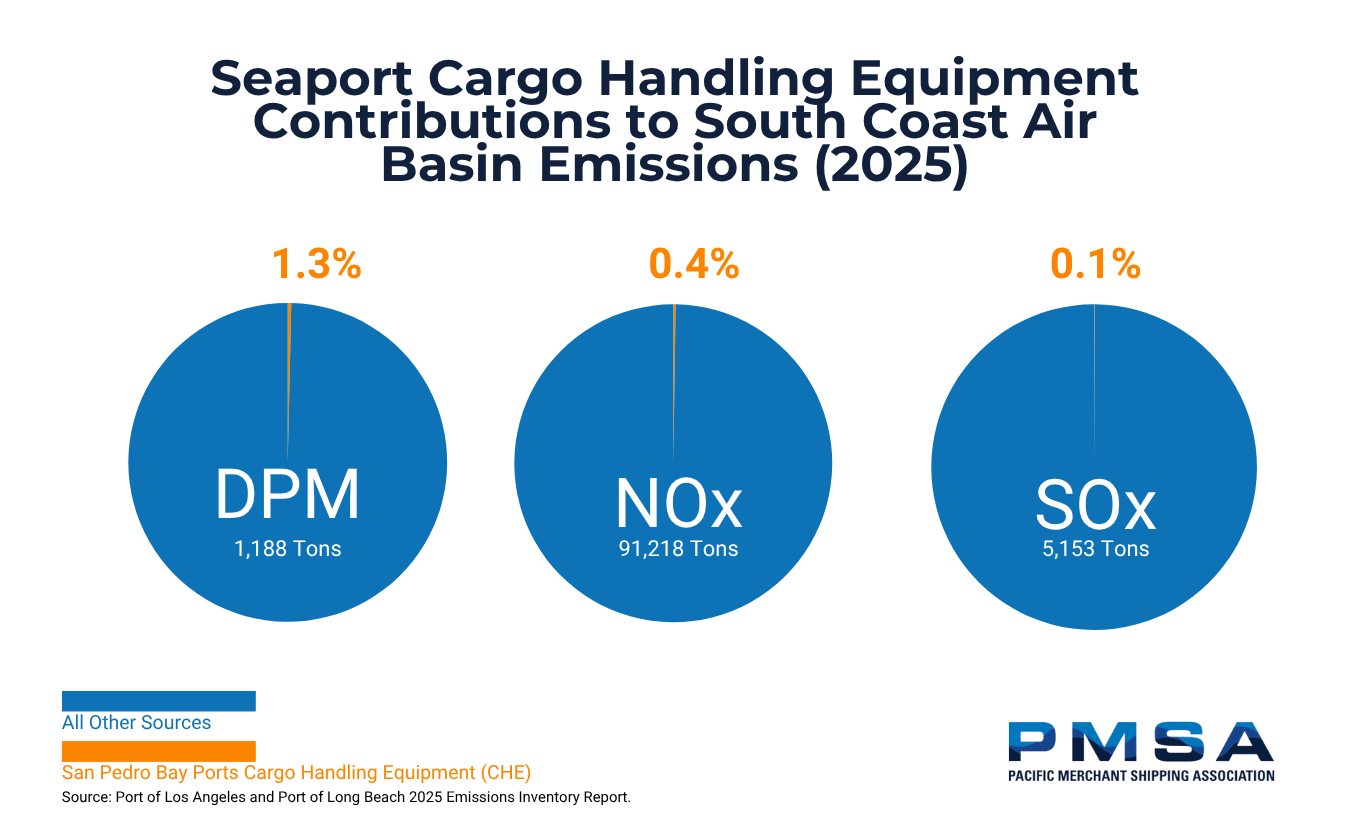
These 2025 San Pedro Bay Port emission reductions are proof yet again we can achieve historic growth in container volumes in tandem with environmental stewardship. The next two decades will surely prove to be a transformation of the Ports of Long Beach and Los Angeles towards their zero-emissions and decarbonization goals. Industry is actively investing in new zero-emissions equipment and heavy-duty trucks, with the international maritime industry as a whole focusing efforts on reaching net-zero GHGs with over $200 billion in private investment in ships capable of running on Sustainable Maritime Fuels (SMFs). Given these investments, we expect to continue to outperform our CAAP goals for many years to come.

Jacqueline M. Moore serves as Vice President for Pacific Merchant Shipping Association (PMSA) in the Long Beach office.
Ms. Moore engages with regulators, policy makers, and industry to promote feasible and sound maritime environmental and safety matters at the regional, state, and federal levels. As a trained scientist, she proudly provides a unique perspective in the public policy forum.
Ms. Moore has dedicated her career to the goods movement industry in various capacities in private and government roles. Prior to joining PMSA, Jacqueline oversaw environmental policy, planning, compliance, and regulatory activities at the Port of Long Beach and BNSF Railway Company. Ms. Moore also worked in the Office of the Chair, Ombudsman’s Office at the California Air Resources Board, aiding businesses in interpreting and complying with air quality regulations.
Jacqueline earned a Master of Science in Climate Change with an emphasis in Policy from University College London in the United Kingdom. She is also a California State University graduate.