
Are Bulk Wine Imports Increasing?
Gallo Winery announced plans on June 8 to scale back its San Joaquin Velley production facilities in Lodi. The company will reportedly close down its Turner Road grape crushing operation in that city but will keep its local bottling and blending operations running. The move has prompted an outcry from the local Lodi Winegrape Commission.
“It's not surprising considering our largest companies are continuing to import millions of gallons of bulk wine instead of choosing local grapes to purchase. We're seeing this across California as our largest wine companies continue to divest from California and are choosing imports over domestic production," Stuart Spencer of the Commission told Sacramento’s ABC affiliate, KXTV News.
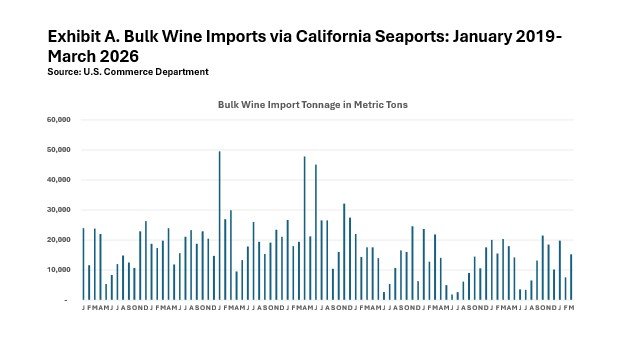
Scapegoating foreign trade has long been a staple tactic of domestic businesses that have been caught on the wrong side of broader market trends, such as in this case a precipitous fall in wine consumption. For at least the past three or four years, California has been growing far more winegrapes than are needed to supply shrinking demand, particularly among younger imbibers. Tens of thousands of acres have been taken out of production, while many growers have found it unprofitable to harvest the fruit still on the vines.
So are domestic wine producers actually increasing their use of imported bulk wines rather than buying grapes from their old suppliers? Not according to the official U.S. import statistics published by the U.S. Commerce Department.
Clearly, the bulk wine import trade had seen rosier times, especially during the stay-at-home months of the COVID-19 pandemic. However, bulk wine imports in the first quarter of this year were down by 23.8% from the same period last year, which was down 4.1% from the first quarter of 2014. The peak month for bulk wine imports came in January 2021, when 49,583 metric tons of wine arrived at California’s ports. The second and third leading months for bulk wine imports were April 2022 (47,800 MT) and June 2022 (45,171 MT). Each of these three months saw more bulk wine imported than during the entire first quarter of this year. So while winegrape growers around Lodi may have some cause for complaint, the case against is less compelling.