
Beyond the Mega-Ports: Who Plays in Which League?
Some years ago, a “Four Corners Strategy” was widely touted as an answer for shippers seeking to minimize the risk of supply chain disruption by diversifying the ports through which they traded. It was a notional concept, rhetorically appealing perhaps to those who felt that America’s largest West Coast ports had become singularly unreliable conduits for international trade, but otherwise not well thought out. Indeed, proponents of the strategy never got around to specifying the boundaries of their four corners or identifying which ports were situated in each corner. As a recent column in this newsletter observed, it was never clear where the Port of Houston stood.
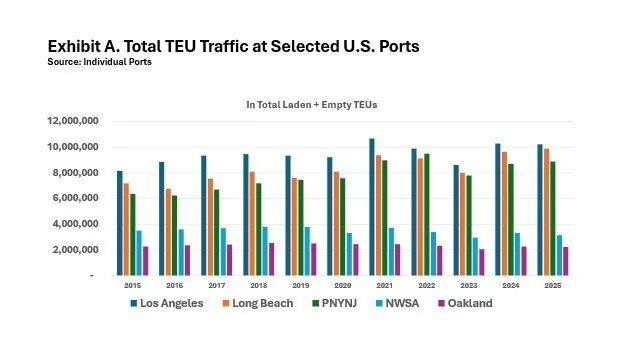
This begs the question of which league ports play in. It is hardly fair, nor particularly revealing, to include the Ports of Oakland and the Northwest Seaport Alliance’s Ports of Tacoma and Seattle in the graphical display with the nation’s three mega-ports (Los Angeles, Long Beach, and the Port of New York/New Jersey), as we have done in Exhibit A. If nothing else, it’s grossly unfair to the ports handling smaller volumes of container traffic.
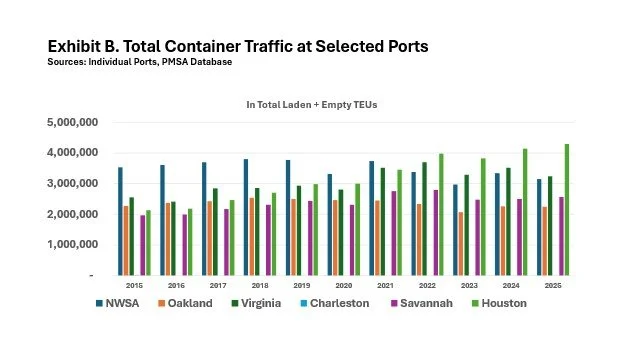
So who are the peer ports against which Oakland and NWSA should be measured? Arguably, their performance should be gauged against the other ports shown in Exhibit B.
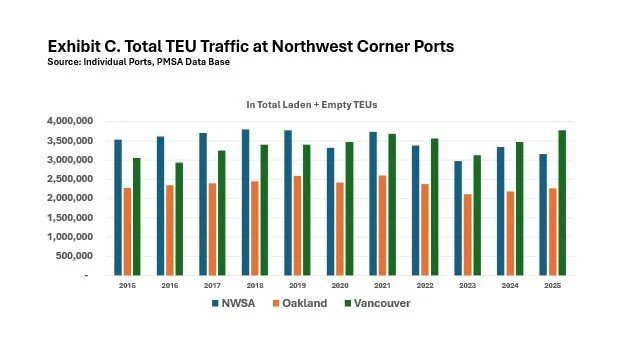
Now, where should British Columbia’s Port of Vancouver go in the Four Corners scheme? It, rather than Northern California’s Port of Oakland, is the rival against which the Northwest Seaport Alliance most directly competes for containerized business, as Exhibit C indicates.