
California’s Trade Is Stable amid Policy Shifts and War in Iran
By Daniel Parayes-Montoya, Research Associate at the Public Policy Institute of California
Despite uncertainty amid actions by the federal government, California’s trade did not shrink; it shifted. US trade policy has been in flux since early 2025, with the roll out of tariffs; ongoing negotiations with China, Canada, and other countries; and the Supreme Court striking down tariffs imposed under the International Emergency Economic Powers Act. These patterns continued into 2026 and coincide with a trade decline between California and key partners, the rising importance of trade with Vietnam and Taiwan, and modest growth in total.
Through July 2026, California’s total merchandise trade (imports + exports) grew 7.3%, to $417 billion, driven by a jump in exports (2.8%) and imports (9%). That marks an acceleration compared to the same period in 2025, when total trade grew just 2.5%, and from all of 2025, when trade barely grew (0.1%).
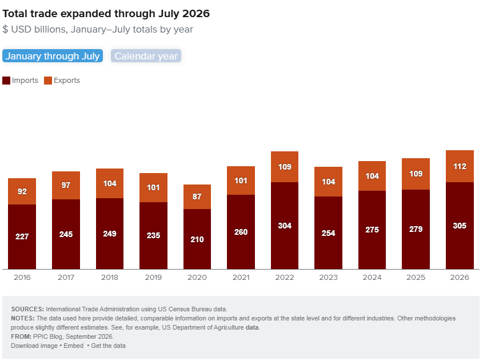
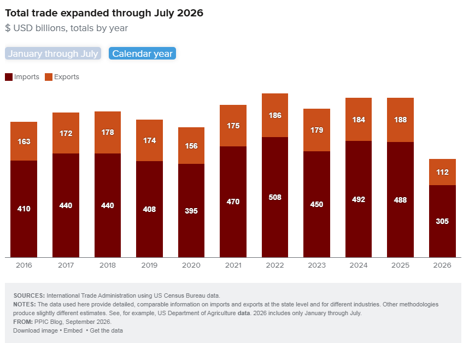
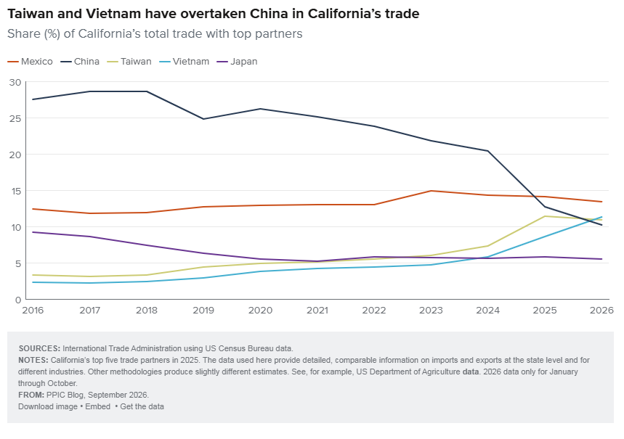
Several trends we highlighted in January have deepened. Mexico remains California’s top trade partner, with little change in its overall share of state trade. China, meanwhile, keeps falling behind, driven mainly by a drop in imports. Some of this decline is due to goods routed through other countries to sidestep US tariffs and other trade barriers. Vietnam is one such country, becoming California’s top source of imports in the first seven months of 2026. Imports from Taiwan also keep climbing, as California’s tech industry buys more computer equipment, semiconductors, and related hardware to build out AI infrastructure; imports of these products from Taiwan alone reached roughly $49 billion in 2025.
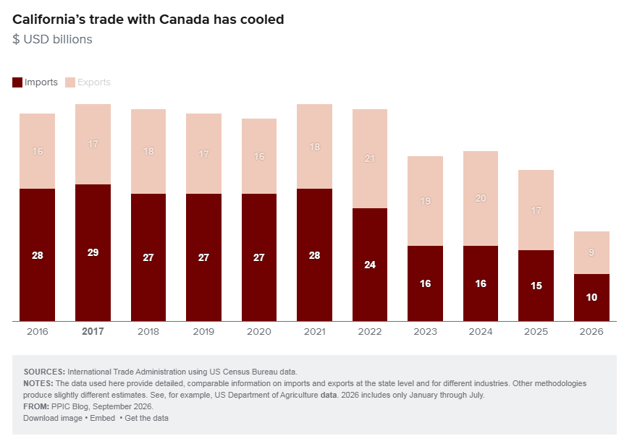
Ongoing concerns with other regions have frustrated operations for key sectors and businesses in the state. First, trade with Canada continues to lose ground. Exports to the state’s second-largest export destination fell from an average of 11% between 2016–2024 to 9% in 2025 and 8.3% in 2026. In addition, the Canadian government recently implemented counter-tariffs of up to 50% on 648 categories of US goods, which accounted for at most $3 billion in California exports to Canada in 2025 (18% of total exports to Canada). Transportation equipment accounts for the bulk of the exposed trade value, followed by electronics, which face the steepest rates.
Second, the war in Iran and the closure of the Strait of Hormuz raises concerns about trade related to energy and other goods (as well as for gas prices and the overall economy). California’s direct trade exposure is modest, overall. Total trade with countries that rely most on the strait was $11 billion in 2025—just 1.7% of California’s total trade. Iraq, the United Arab Emirates, and Saudi Arabia accounted for more than 90% of that total. On the export side, the state exported $4.3 billion to these countries in 2025, or 2.3% of California exports.
However, for specific goods, the exposure is greater. In 2025, 8.8% of the state’s total exports in miscellaneous nuts—a customs designation that includes almonds and pistachios—went to these countries (or $860 million); through July 2026, that share dropped to 5.7% (or $360 million).
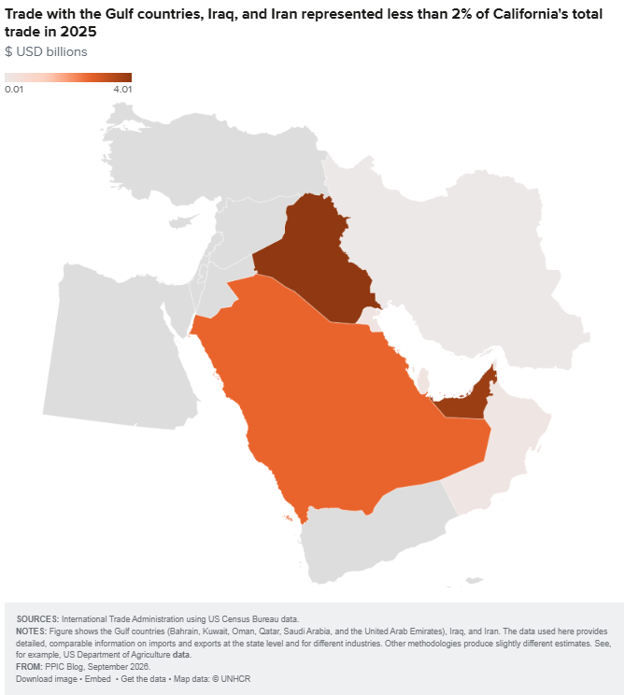
The largest import from the region is crude oil—$6.2 billion in 2025, close to a third of California’s total crude oil imports (63% of that value came from Iraq; 26% from Saudi Arabia). As of July 2026, oil imports from the region were cut from $4 billion in 2025 to $1.8 billion, as the state’s total oil imports fell 15%.
So far, California has managed to increase oil imports from other trading partners. Still, an extended disruption of global oil markets could reach the state through price shocks and reduced access to a key input for economic activity: foreign sources supplied 61% of the crude oil refined in California last year.
Despite policy changes and an active war, California’s trade volume has remained relatively resilient through 2026 as it shifts away from long-standing partners to new ones. While the state has diversified its oil suppliers, a prolonged closure of the Strait of Hormuz could still reach California businesses and consumers through higher energy prices. As with past disruptions, the ability of the state’s exporters, importers, and policymakers to keep diversifying markets, supply chains, and energy sources will determine how well the resilience holds for the rest of the year.

About Daniel Payares-Montoya
Daniel Payares-Montoya is a research associate at the Public Policy Institute of California. He is a member of the PPIC Economic Policy Center, and he also contributes to the PPIC Higher Education Center. His research focuses on expanding economic opportunity through the labor market, the relation between the labor market and higher education, income inequality, climate-related jobs, and economic development. Before joining PPIC, he worked as a consultant for the World Bank, concentrating on green growth and green finance in developing countries, and as a researcher at the Center for Latin American Studies, University of California Berkeley, focusing on the socio-economic impact of globalization and industrialization in the Americas. He has also conducted research on productivity, education, and labor markets for Fedesarrollo, the Private Council on Competitiveness, and Proantioquia Foundation in Colombia. He holds a master’s degree in public policy from Universidad de Chile and a master’s degree in development practice from the University of California, Berkeley.
Read more at the Public Policy Institute of California website.