
Tanks for the Chips, Taiwan
The past year has been very good for those with investments in defense stocks. Shares in General Dynamics, for instance, were trading under $270 at the start of the year. They can be currently had for nearly $100 more. Similarly, shares of Raytheon have risen from under $120 to over $200 in the same period.
Exports of military hardware have likewise soared. Shipments of HS 9301, a broad category of military weapons, jumped by 61.7% last year. Exports of Artillery were up 72.2%. In a separate category (HS 8710), exports of Tanks & Other Armored Fighting Vehicles increased by 38.6%.
While a good deal of the arms trade moves, often under urgent circumstances, by air, ports and ocean carriers play a major role, especially with heavier items such as tanks and other motorized armored fighting vehicles.
Other than shipments to neighboring Canada and Mexico, nearly all exports of tanks, armored personnel carriers (APCs), and other fighting vehicles are transported abroad by sea. In 2025, that trade was valued at $2.193 billion, a 38.2% bump over the previous year. In view of current developments, it should not be surprising that Poland was the leading destination of HS 8710 shipments, accounting for 30.0% of oceanborne exports, with Taiwan and Israel following behind with 19.3% and 11.9% shares, respectively.
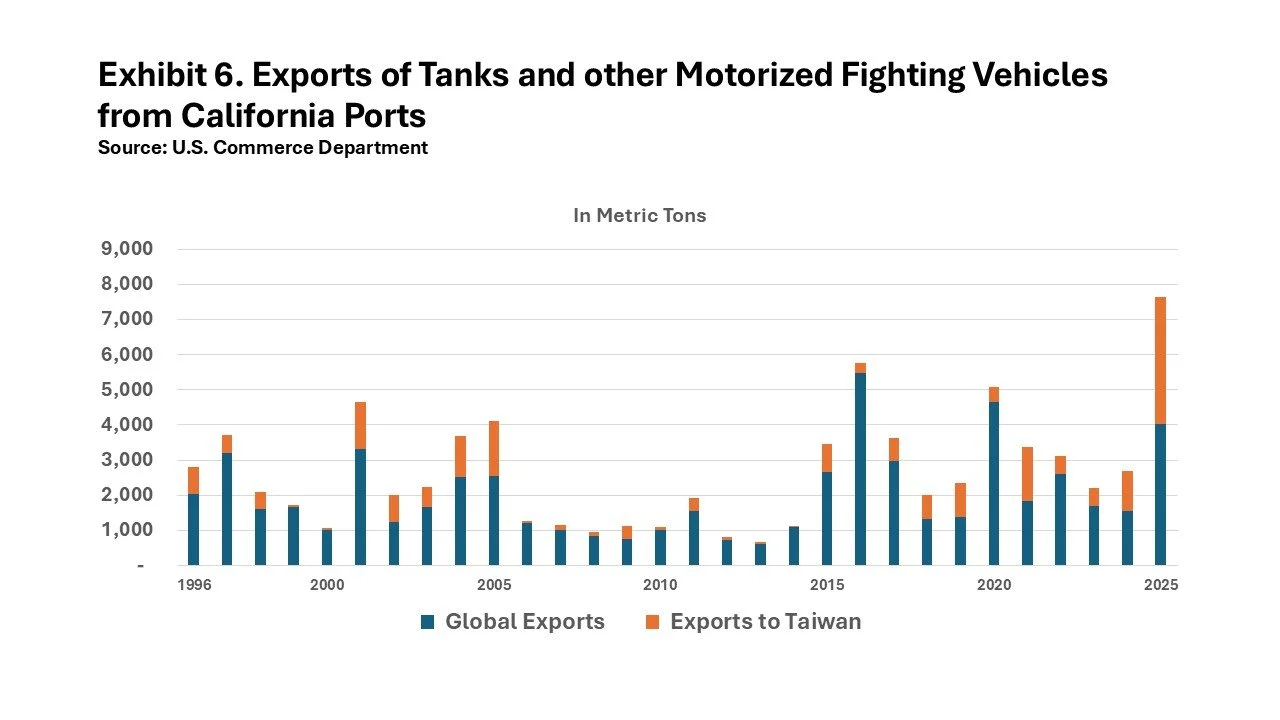
Tanks bound for Poland typically move out through the Ports of Jacksonville, Charleston, and Baltimore. Israel gets its tanks primarily from the Port of Philadelphia and the Port of New York/New Jersey. U.S. West Coast (USWC) ports play no appreciable role in supplying tanks to either Poland or Israel. Taiwan, though, is another story. Nearly all tank shipments to Taiwan emerge from the Ports of Long Beach and Los Angeles.
USWC ports, in fact, dominate the shipment of tanks not only to Taiwan but to other East Asia countries. Last year, 97.8% of tank shipments to East Asia left through the two San Pedro Bay ports. The Port of Hueneme chipped in with a 0.5% share of the trade.
Beleaguered Taiwan has lately been an avid customer for American tanks, with purchases in the last two years dwarfing their previous imports. In the two decades between 2003 and 2023, Taiwan imported $593.047 million worth of tanks from the United States. In just the last two years, its imports totaled $731.459 million.
Interestingly, the surge in tank shipments to Taiwan through the Ports of Los Angeles, Long Beach, and Hueneme was greatly responsible for the fact that Taiwan has leapt from fifth to third place among California’s export markets. In doing so, it bested Japan. (China fell to the fifth spot as trade friction between Beijing and the White House has greatly affected established patterns of trade.)
In return, California has not been buying tanks from Taiwan. Instead, the $63.465 billion in Taiwanese imports to California was exceedingly heavy in computer chips and other electronic equipment. The top consumer import, bicycles, accounted for just 0.17% of all Taiwanese imports to California last year.
Taiwan, a beleaguered island nation of 23 million people, is America’s tenth largest export customer, having imported $54.666 billion in goods from the U.S. in 2025, up a remarkable 28.5% from the previous year.
Ohio is the top exporting state for HS 871000 (tanks and other motorized fighting vehicles, including parts). Last year, 24.9% of 37,871 metric tons of these vehicles exported from the U.S. were attributed to the Buckeye State. New York State ran second, with an 18.7% share of the trade. California (10.6%), Alabama (8.9%), and Wisconsin (8.4%) rounded out the top five tank exporting states.
Lately, the besieged island of Taiwan has emerged as California’s third largest export destinations, overtaking both China and Japan. Last year, Taiwan imported goods valued at $14.301 billion dollars from the Golden State, more than the $11.014 billion Japan bought from California and certainly much more than the $10.272 billion in California merchandise imported by China.
It’s intriguing how a nation of 23 million imports more merchandise from California than does 123 million Japanese, much less the 1.4 billion residents of China. Much of the change can be attributed to the trade dispute between the Washington and Beijing. In 2010, California’s exports to China first began to seriously exceed the value of shipments to Taiwan. In 2023, the last full year before the presidential election campaign disrupted America’s trade relations, the Chinese imported $16.900 billion from California, more than twice the $8.841 billion in California exports that went to Taiwan.
California exported $513.376 million in tanks and other motorized fighting vehicles last year, up 5.2% from a year earlier but an astonishing 797.2% jump over the $54.436 million the state had shipped abroad in 2023. Last year, the Golden State ranked second only to Ohio as the source of U.S. armored fighting vehicle exports.
Other than exports to neighboring Canada and Mexico, which bought only $60.493 million in motorized fighting vehicles from us last year (mostly parts and accessories), nearly all HS 871000 shipments abroad travel by sea last year. Other than exports to neighboring Canada and Mexico, which bought only $60.493 million in motorized fighting vehicles from us last year (mostly parts and accessories), nearly all HS 8710 shipments abroad travel by sea last year.
On average, oceanborne exports of HS 8710 had a declared value last year of $57,916 per metric ton. HS 8710 shipments from Florida’s JaxPort in 2025 were valued at $64,300 per MT. The same commodity shipped from the Ports of Los Angeles and Long Beach were reportedly worth $116,526 per metric ton, suggesting more sophisticated machinery.
The Port of Oakland shipped 1,022 metric tons of HS 8710 last year with a value per MT of $57,151, while the Northwest Seaport Alliance Ports of Tacoma and Seattle handled only a tiny sliver of the trade, with just 9 metric tons valued at a total of $205,458.
One of the smaller U.S. West Coast ports, Port Hueneme, shipped 1,879 MT of HS 8710 last year, exports valued at $71,733 per MT.
We acknowledge that shipments overseas of Tanks and other Motorized Fighting Vehicles may be exported aboard naval vessels and would, therefore, be shielded from the recordkeeping procedures of more routine forms of commerce.