The Ports of Halifax and Mobile
The Port of Halifax
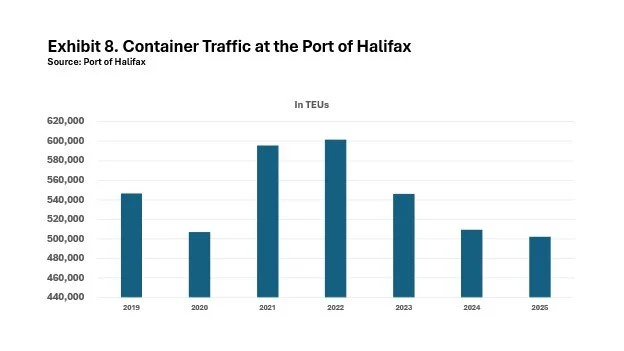
We normally we do not feature Canada’s fourth largest seaport, the Port of Halifax, because the port does not publish detailed monthly container statistics. So, even though port officials report that 98% of the cargo tonnage passing through the port is containerized, we are only told how many TEUs arrived and departed each quarter. And, even then, the figures released by the port do not distinguish loaded from empty containers. Exhibit 8 displays what we know about the box trade handled by the storied Nova Scotia port.
Container traffic through Halifax last year totaled 502,180 TEUs, down 1.4% from the preceding year. Inbound trade in CY 2025 amounted to 257,552 TEUs, a 2.9% fall-off from a year earlier. Outbound loads of 244,628 TEUs were up 0.3% year-over-year.
The Port of Halifax has played an important, perhaps even outsized role in trade between North America and Europe, especially with the United Kingdom of which it was formally an integral part until 1867, when Nova Scotia joined New Brunswick, Quebec, and Ontario to form the Dominion of Canada.
In 1840, Cunard Lines routed the first transatlantic mail service between Britain and North America through Halifax. Thirty-two years later, the Intercolonial Railway opened. A forerunner to the Canadian National Railway, it linked Halifax with North America’s fast-expanding rail networks. In 1912, Halifax launched the principal Titanic rescue/recovery efforts shortly after wireless distress calls were received by the city’s Marconi station. Five years later a French munitions ship, the Mont Blanc, collided in Halifax Harbor with a Belgian relief ship, the Imo, leading to what is described as the world’s largest man-made explosion before the nuclear age. The blast killed an estimated 2,000 people, injured 9,000 others and destroyed 325 acres of land. Container service at the port began in 1969.
Canada did not begin gluing itself together until July 1, 1867, when the legislatures of the Province of Canada, New Brunswick, and Nova Scotia agreed to a federation. Two concerns propelled the formation of a sovereign nation. The one that most resonates today was a fear that a disjointed set of territories would be vulnerable to the United States, especially as Britain was becoming increasingly reluctant to defend its interests in North America at a time when its financial interests were more closely aligned with those of the U.S.
The other concern driving national unity was the need to build the transportation infrastructure needed to weld the new confederation together. That took the form of the Intercolonial Railway, which was eventually absorbed into the Canadia National Railway. Much of the impetus for railroad development came from the imperative of linking Halifax. the emerging nation’s principal Atlantic Coast seaport, with the cities and industries that sprawled across the vast continent.
Provisions in the confederation pact allowed British Columbia, Newfoundland, and the North-West Territory (then called Rupert’s Land) to join in later years. British Columbia joined in 1867, and Prince Edward Island in 1873. But Newfoundland waited until 1949 to join the Confederation that is Canada.
The Port of Mobile
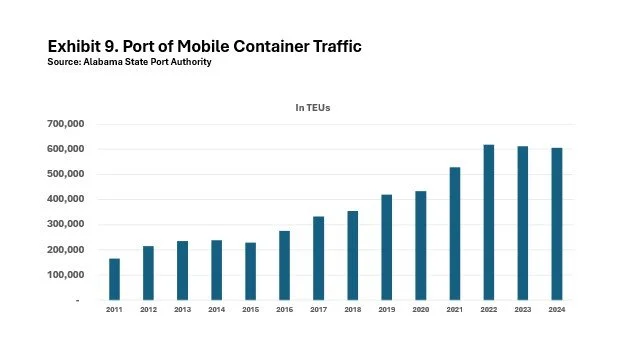
The Alabama State Port Authority (ASPA) does not routinely post statistics on container operations at the Port of Mobile. There are no monthly reports about TEU traffic, and the most recent information about container volumes comes in the back pages of the ASPA’s Annual Comprehensive Financial Report, the latest of which covers its 2023-2024 fiscal year.
Exhibit 9 displays pretty much all the data publicly available about the remarkable growth of container traffic through the Gulf Coast port.