
Containerized trade between the United States and the six Middle Eastern nation’s comprising the Gulf Cooperation Council (Bahrain, Kuwait, Oman, Qatar, Saudi Arabia, and the United Arab Emirates) is not inconsiderable. Last year, U.S. ports shipped $13.056 billion in containerized merchandise to the GCC, while the GCC states exported $6.218 billion in containerized goods to the United States.
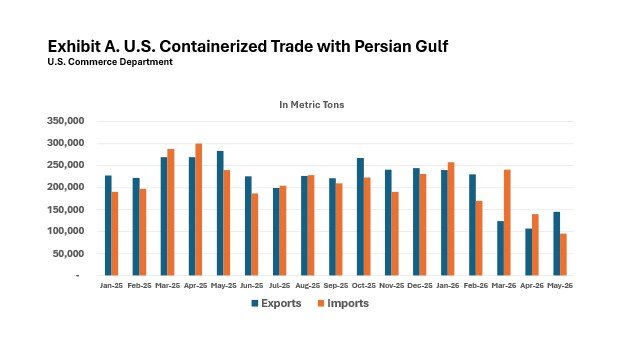
The sudden outbreak of hostilities on February 28 has severely affected that two-way trade, as Exhibit A demonstrates.
U.S. containerized export tonnage to the GCC was down 48.7% in May from a year earlier. That was an improvement over April, which saw a 60.1% drop in containerized export tonnage shipped to the GCC countries. In March, the first full month after hostilities commenced, U.S. containerized exports to the GCC plunged 54.0%.
Similarly, GCC exports to the United States have been seriously impeded. This May’s containerized imports from the GCC plummeted by 60.4% in tonnage terms and 51.6% in dollar value.
Most of America’s containerized export trade to the Gulf Cooperation Council (GCC) originates at East and Gulf Coast ports. Port Houston accounted for 20.0% of the trade in 2025, while the Port of Savannah contributed 18.4% and the Port of New York/New Jersey 14.9%.
On the U.S. West Coast, the Ports of Los Angeles and Long Beach last year accounted for 16.1% of U.S. containerized exports to the GCC, while the Port of Oakland had a 5.4% share, slightly more than the 5.1% share held by the Northwest Seaport Alliance Ports of Tacoma and Seattle.
This year, containerized exports from the Ports of Los Angeles and Long Beach to the GCC plunged from 36,069 metric tons in May 2025 to 304 metric tons this May. The 4,801 metric tons of containerized exports shipped to the GCC has fallen to zero this May at the Northwest Seaport Alliance ports.The conflict has likewise dented exports to the GCC from the Port of Oakland. The San Francisco Bay port’s 6,576 metric tons exports to the GCC in May of last year have toppled to 3,501 metric tons this May, a decline that would have been sharper were it not for a dramatic upsurge in orders for tomato paste, which increased from 585 metric tons last May to 1,192 metric tons.