
By Jock O’Connell, Economist
The air might be more pristine and the water purer in the State of Oregon, but what’s not so clear is why so many of the Beaver State’s leading citizens have evidently persuaded themselves that its ports should play a paramount role in America’s maritime trade.
Let’s review the situation. Back in April 2024, officials at the chronically struggling Port of Portland formally advised stakeholders that they lacked the funding necessary to sustain container operations at the Port’s Terminal 6 (T6).
Accordingly, “we have made the difficult decision to cease operations [at T6] as of October 1, 2024.”
This came in the wake of a press release the Port had sent out a month earlier, in which it was revealed that the Port had “endured losses of more than $30 million from container operations over the past three years, including a projected $14 million shortfall in the current fiscal year”.
Truly, things looked bleak.
“Our losses began to really get deeper than we could manage on our own,” Port Director Curtis Robinhold told Oregon Public Radio. “So we signaled publicly that we weren’t going to keep the doors open anymore — we just couldn’t bear these losses over more than the couple years that we had. We were losing about $12 [million] or $13 million a year, which is essentially all of our public money, so we were unable to do the other parts of our mission because this one piece of business was essentially eating all of the investment.”
The impending termination of the Port’s container business hardly shocked anyone in the maritime trade industry. In today’s world of container shipping, the deck is stacked against smaller ports serving smaller markets. More and more, it’s an industry of big ships calling at big ports.
But the closure announcement did not go down well at all with local shippers, the region’s agricultural exporters, and their allies at the state capital in Salem.
Within a month of the termination notice, the Port was obliged to row back its termination notice. On May 16, 2024, Port executives issued a new press release that now declared their intention to “continue providing container shipping services at Terminal 6”.
That’s the kind of abrupt reversal my neighbors in Italy, using both hands, would call a voltafaccia.
After some back-and-forth between the Port’s leadership and state officials, and after the production of an exceedingly optimistic consultant’s forecast, Oregon Governor Tina Kotek agreed to set aside upwards of $10 million in taxpayer money to underwrite the Port’s losses at T6, at least for a while.
So the politically chastised Port sailored on, without much evidence that local shippers, who had promised to send more containers through T6 if it were kept operational, were in fact doing so.
Still, the optimists persisted. Last September, T6 acquired a new terminal operator, Harbor Industrial Services, the California-based firm which had previously provided stevedore services at the terminal. And, as of the start of this year, Terminal 6 was rechristened as the Oregon Container Terminal.
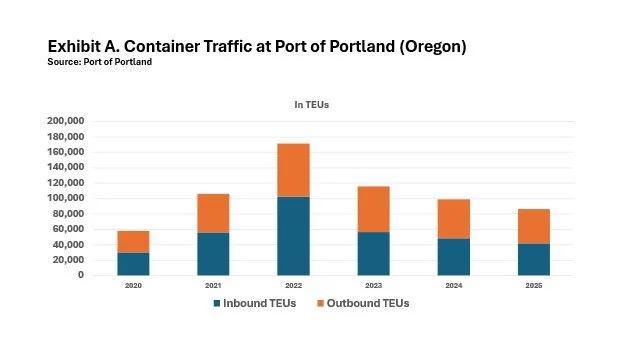
It is far from obvious that any of these moves will have a material impact on container volumes at the Columbia River port. In deciding to pull the plug on container services at T6 back in the spring of 2024, the Port’s leaders were conceding that container volumes were not generating enough revenue to offset the expense of continued operation. Yet, as Exhibit A shows, there has been no improvement.
The 86,387 TEUs the Port handled in 2025 were the fewest in any year since regular container operations resumed at T6 in 2020. Last year’s inbound container volume of 42,002 TEUs lagged the volumes recorded in 2024 by 13.1%. Outbound traffic (44,386 TEUs) was down 12.2% from a year earlier.
Those are figures that hardly suggest the flow of red ink has been stanched. If the port had been losing money in 2024, it is fair to assume that the port has been losing even more money on the fewer TEUs it has lately been handling.
Achieving healthier levels of container traffic through the Port is not simply a marketing challenge that can be addressed with new signage and colorful brochures. The real obstacles to growth at the Port are structural.
As Port officials acknowledged in a March 2024 document, Terminal 6 “faces a number of unique challenges, including its distance 100 miles from the ocean, the region’s relatively small consumer market (to draw imports) compared to other West Coast cities like Los Angeles and Seattle, and the Columbia River’s limited depth to accommodate the largest ships in the shipping industry.”
That’s not the only impediment to Oregon Container Terminal’s future viability.
The folks in charge in Oregon have lately embraced a proposal to construct a competing Pacific Coast Intermodal Port at Coos Bay.
I’ll pause here while readers consult Google Earth to see where Coos Bay is and then puzzle over why anyone would seriously consider it as a candidate for an enormous investment in maritime infrastructure. As the highly respected maritime trade consultant Walter Kemmsies told the Oregon Journalism Project recently: “Who is asking for another terminal on the West Coast?”
No one that I know.
At least two questions instantly pop into mind:
1) What about Coos Bay recommends itself as the site of a container port intended to serve America’s transpacific trade, as its proponents propose?
2) Would not a Coos Bay Intermodal Port ultimately put the Port of Portland’s Oregon Container Terminal out of business?
According to local news reports and some superb investigative reporting by the Oregon Journalism Project, the Oregon International Port of Coos Bay has partnered with a Kansas City outfit called NorthPoint Development to push for a state-of-the-art container terminal on property the Port owns. The facility would move containers by rail to and from markets nationwide via the 134-mile port-owned Coos Bay Rail Line, which would link up at Eugene with trackage controlled by the Union Pacific Railroad. The stated goal is to “provide additional capacity for imports, create a new gateway for U.S. exports, and generate a significant economic impact in rural Oregon.”
The project has attracted formidable political support. Both of Oregon’s U.S. Senators have signed on, as has the House of Representative member from the district encompassing Coos Bay. Their support helped gain the project a $25 million grant from the U.S. Department of Transportation in October 2024. (There is no indication that the Trump administration intends to rescind this bit of Biden administration largesse.) Governor Kotek heralded the grant as “a critical step in the effort to establish a vital intermodal gateway for west coast imports and exports at the Port of Coos Bay”.
It’s not at all clear what is propelling such aspirations apart from an increasing sense of desperation about Coos Bay’s economic prospects. From a strategic perspective, it would be like a National Football League team keeping a sixth-string quarterback on the roster. Very simply, building a brand-new maritime gateway on the Pacific Coast is not a justifiable use of infrastructure funds.
As much as project proponents have been emphasizing the congested conditions that stymied container traffic through the major U.S. West Coast ports during the busiest months of the pandemic’s import surge, that spike was truly an anomaly, a classic Black Swan event. Adding new capacity to handle barely predictable developments is a squandering of scarce resources.
In this case, claiming that the nation needs a new container port on the West Coast to handle higher and higher volumes of container trade ignores the fact that existing ports are hardly being overwhelmed by TEUs. Even then, the five major U.S. West Coast ports are all investing to improve their throughput rates.
We have already seen the foundering of TEU traffic through the Port of Portland. What of other Pacific Coast ports?
The Ports of Los Angeles and Long Beach simply play in a league of their own. While they have lost market share to East and Gulf Coast rivals, they have consolidated their dominance of the box trade moving through the West Coast.
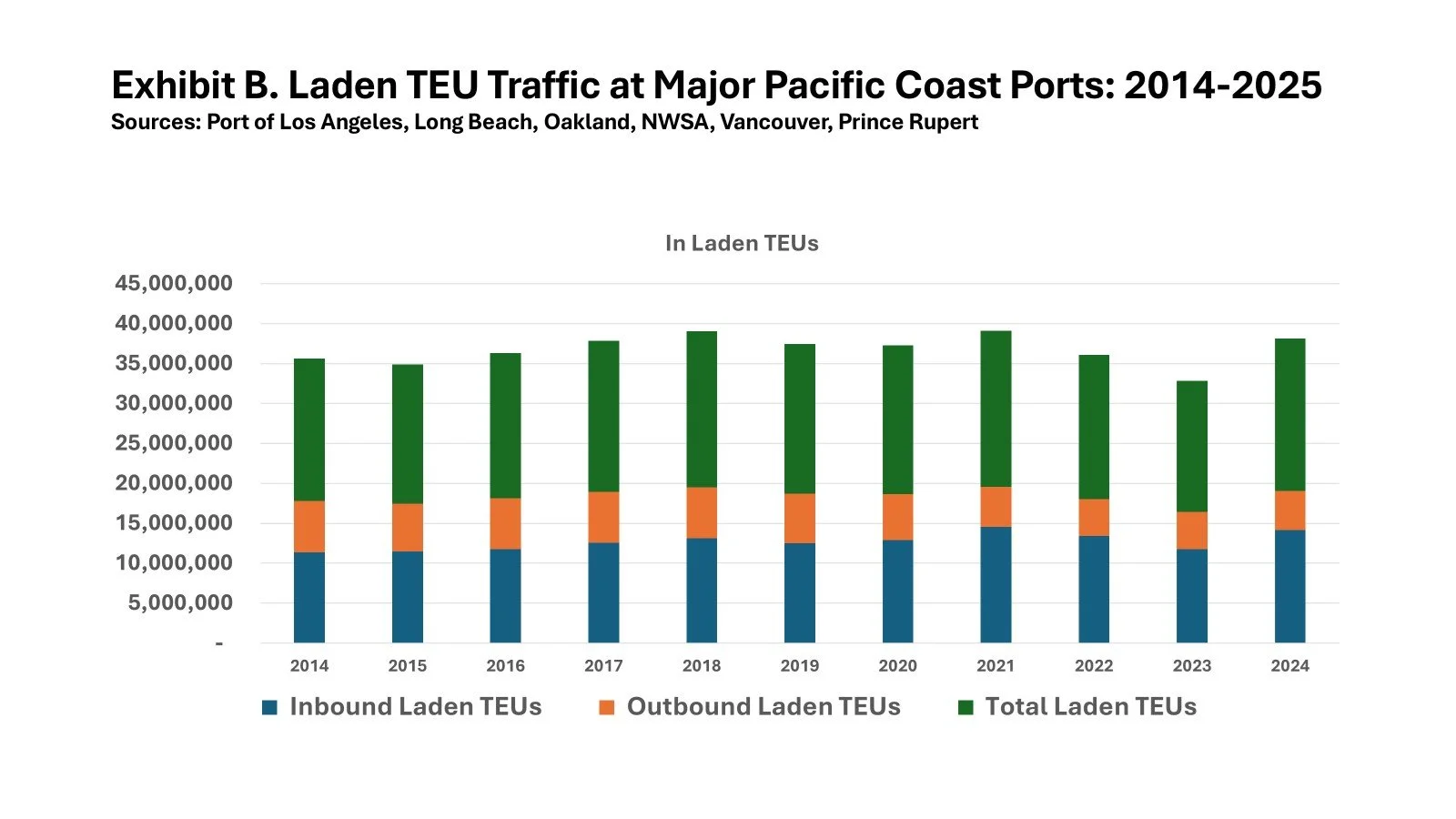
The Port of Oakland just finished 2025 with 2,253,978 total TEUs, fewer TEUs than it had handled twenty years earlier! Still, the San Francisco Bay port has embarked on a number of projects, including the widening of its turning basins to accommodate much larger ships and capture higher volumes of containerized trade.
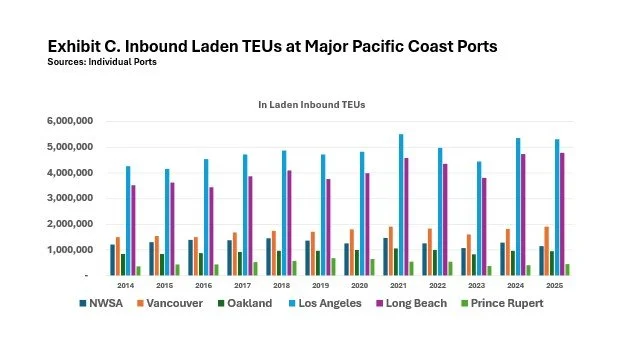
In neighboring Washington State, container traffic through the Ports of Seattle and Tacoma, has actually declined over the past ten years. Loaded TEUs exported from the Northwest Seaport Alliance (as the two Puget Sound ports are marketed) totaled 871,476 TEUs in 2015, but only 605,126 ten years later in 2025. Import loads similarly declined from 1,308,155 in 2015 to 1,157,002 TEUs last year.
Across the border in British Columbia, the Port of Prince Rupert offers a useful lesson about introducing new capacity. When the port was designated by the Canadian government as a National Harbour in 1972, the port’s Fairview Terminal was expected to assume a larger and larger share of North America’s container trade with East Asia. While the 885,797 TEUs the port handled in 2025 is not an inconsiderable volume, it was 26.8% down from the volume that passed through the port in pre-pandemic 2019.
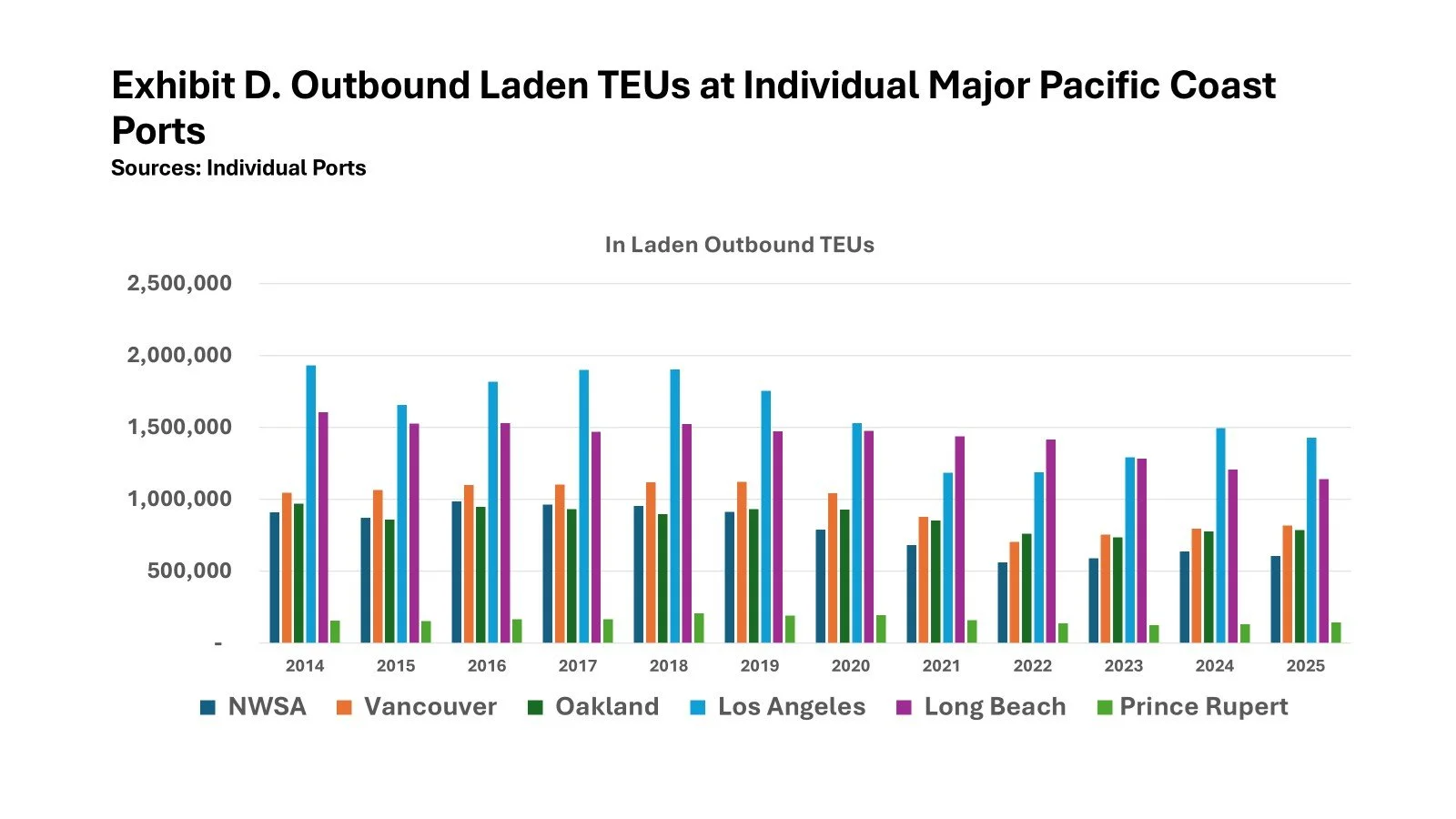
Of the Pacific Coast ports outside of Southern California, only the Port of Vancouver has recorded gains in TEU traffic. While the British Columbia gateway did see its total container traffic grow between 2019 and 2025, the 3.8 million TEUs the port handled in 2025 was still well shy of the 5.5 million TEUs that a 2020 Vancouver Fraser Port Authority forecast had predicted for 2025.
Exhibits B through D illustrate that, apart from the two Southern California ports and the Port of Vancouver, the chief ports along the Pacific Coast have not been seeing the sort of expanding container trade that might warrant consideration of a new maritime gateway, especially one priced in the tens of billions of dollars.
Finally, consultants’ typically buoyant forecasts notwithstanding, the prospects for a new maritime terminal at Coos Bay will remain daunting even if we are able to move on from this era of injurious tariff disputes and the shifting trading patterns they have induced. Maritime infrastructure planners have ample reason to rein in their expectations of relentless growth in the transpacific container trade.