
Record Volumes, Efficiency Gains, and Environmental Apex Amidst the Chaos: Los Angeles and Long Beach Seaports Close Out 2025 with Historic Achievement
By Mike Jacob, President, Pacific Merchant Shipping Association
The Ports of Los Angeles and Long Beach closed out 2025 by achieving what many thought impossible amidst the year’s chaos: setting a new all-time container volume record. And, we achieved this milestone while simultaneously demonstrating operational and efficiency excellence and unparalleled global environmental leadership.
This monumental performance, only made possible by coordination across the entire spectrum of the players in the Southern California intermodal supply chain, has set the benchmark that defines what a world-class maritime gateway can be.
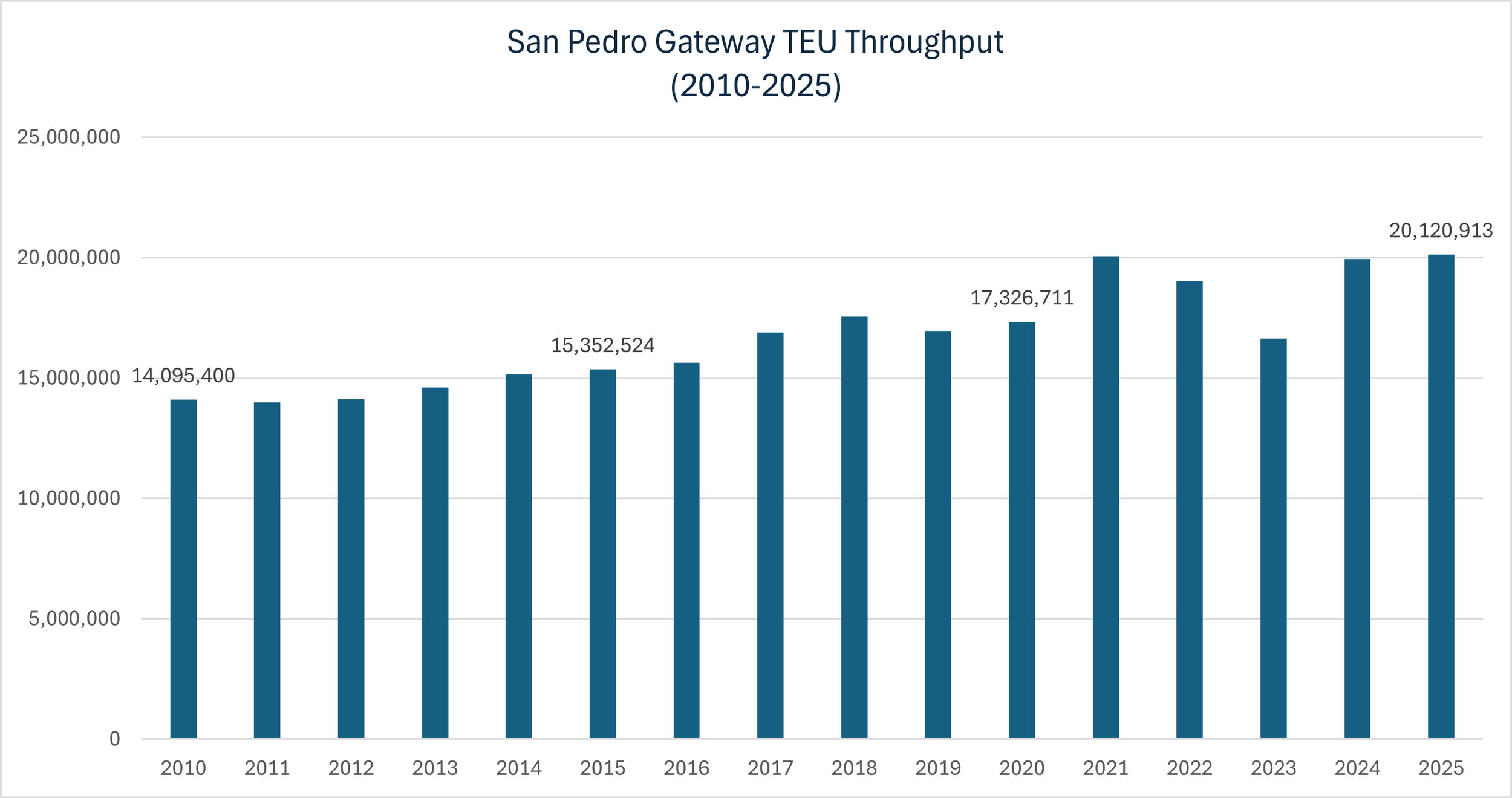
Together, the San Pedro Bay port complex handled 20,120,913 TEUs in 2025—eclipsing the previous record of 20.06 million TEUs set during the chaotic pandemic peak of 2021.
The Port of Long Beach individually set its own all-time record with 9,881,595 TEUs—an extraordinary 29.5% increase over pre-pandemic 2019 levels. The Port of Los Angeles processed 10,239,318 TEUs, up 9.7% from 2019 and representing near-record performance for America's busiest container gateway.
But the real story isn't just about surpassing a number. It's about how these volumes were achieved: with exceptional efficiency amidst unprecedented economic and trade disruption and continued progress on the most ambitious environmental goals of any port complex in North America.
Efficiency That Speaks Volumes
Anyone who lived through 2021 remembers the images that came to define supply chain chaos: more than 100 vessels anchored offshore waiting for berth space, marine terminals overwhelmed with long-dwelling containers, and urgent calls from the White House asking the intermodal supply chain to “save Christmas.” That was the backdrop against which 2021's previous record peak of 20.06 million TEUs were moved.
The contrast with 2025 could not be more stark. Despite handling more cargo than that record year, the San Pedro Bay ports maintained fluid operations throughout 2025 with no significant vessel queues, no terminal congestion crises, and no desperate pleas for intervention.
The data confirms what the industry observed firsthand. Container dwell times—the key performance indicator for measuring marine terminal efficiency—demonstrated remarkable improvement in 2025 compared to recent years. Cargo destined for truck delivery spent an average of just 2.47 days at marine terminals in December 2025, compared to 3.11 days in December 2024. For the full year 2025, truck dwell times remained consistently below or near historic averages, reflecting the resilience that drayage operators and terminal partners built into their operations.
Rail-bound containers averaged 5.14 days at terminals in December 2025, a significant improvement from the 6.53 days recorded in December 2024. While rail cargo continues to face peak-season pressures, the year-over-year improvements demonstrate meaningful progress in intermodal rail throughput—particularly notable given that terminals and railroads handled more rail cargo while achieving faster turn times.
This operational excellence wasn't achieved by accident. It reflects the investments that marine terminal operators, ocean carriers, drayage companies, and railroad partners have made in equipment, technology, processes, and people. The 2025 performance validates a fundamental principle: efficiency and velocity matter as much as—if not more than—raw throughput capacity.
Leading Through Challenging Times
The 2025 achievements at the Ports of Los Angeles and Long Beach stand out even more sharply when considering the unprecedented trade policy turbulence that defined the year. These record volumes were delivered not in calm waters, but in what may have been the most disruptive tariff environment since the Great Depression.
When tariff announcements sent shockwaves through global supply chains and triggered a 12% plunge in U.S. stock markets, they also created operational chaos for businesses trying to plan imports, manage inventory, and maintain supply chains. Tariff rates changed repeatedly as bilateral negotiations proceeded. Some measures were paused for 90 days, then extended, then modified. Exemptions were granted, then revised.
This uncertainty had real operational consequences. Importers rushed to front-run tariff implementations, creating dramatic surges in cargo volumes at West Coast ports ahead of anticipated effective dates. The San Pedro Bay ports experienced record-breaking months during summer 2025—July became the busiest month in the Port of Los Angeles's history—as businesses scrambled to import inventory before tariffs took effect or increased. Then volumes would plunge when the uncertainty became too great or when tariffs actually materialized, creating whipsaw effects throughout global trade lanes.
The Port of Long Beach and Port of Los Angeles, as the primary gateways for Asian imports, found themselves in the trade lanes at the epicenter of these volatile flows.
That the San Pedro Bay ports not only absorbed these dramatic swings but actually set volume records while maintaining operational fluidity speaks to the resilience and adaptability of the entire supply chain ecosystem. Ocean carriers deployed vessels to meet demands that were far from certain. Marine terminal operators adjusted berthing schedules and yard operations to accommodate surges. Drayage companies flexed their fleets to handle volatile demand. Railroad partners worked to expedite intermodal cargo during peak periods. And throughout these gyrations, the efficiency metrics at LA and Long Beach still beat the metrics from 2024.
The 2025 experience demonstrates something critically important: operational excellence and supply chain resilience are not just advantages during normal times—they become essential competitive differentiators during periods of disruption. When trade policy creates uncertainty and volatility, cargo naturally gravitates toward gateways that can deliver reliability, efficiency, and velocity regardless of external chaos. The San Pedro Bay ports proved in 2025 that they possess these qualities in abundance.
Environmental Progress That Sets the Standard
Perhaps the most impressive achievement is that the San Pedro Bay ports moved these record volumes while continuing to reduce emissions and exceed their Clean Air Action Plan goals. The 2024 emissions inventory—the most recent data available—shows that compared to the 2005 baseline, the ports have achieved:
• Diesel Particulate Matter (DPM): -90%
• Nitrogen Oxides (NOx): -70%
• Sulfur Oxides (SOx): -98%
• Greenhouse Gases (GHG): -10%
These reductions were maintained through a period of substantial volume growth—testament to the billions of dollars in environmental investments made by terminal operators, ocean carriers, and supply chain partners. No other industry has committed to, met, and exceeded such significant and sustained emissions reduction goals while simultaneously growing its business.
The connection between volume growth and environmental progress is not coincidental—it's causal. The ambitious environmental programs required to achieve these reductions demand massive capital investments in cleaner cargo handling equipment, shore power infrastructure, and new technology for trucks, railroads, warehouses, and harbor craft. These investments are only economically viable when supported by robust cargo volumes that generate the revenue necessary to fund the next generation of environmental improvements.
Then, to top that off, in November 2025 the Ports and the local air quality management district were able to reach an unprecedented Cooperative Agreement that avoided controversial regulations that threatened to throw the whole system into a litigation maelstrom. Instead of fighting in court and investing in outside counsel, these unlikely Southern California partners are now establishing a framework that prioritizes infrastructure investment and operational excellence over punitive regulatory approaches. This pragmatic approach—focusing resources on technology deployment rather than litigation—has positioned the San Pedro Bay ports to continue leading on environmental performance while maintaining competitive vitality. This win-win agreement creates a pathway for continued environmental progress supported by sustainable business growth.
Building on Success
The record-breaking performance of 2025 was not built in a single year. It reflects decades of strategic investment, collaborative partnerships, and policy decisions that prioritized both operational excellence and environmental leadership. The result is a port complex that can handle unprecedented volumes efficiently while continuing to reduce its environmental footprint. This is a combination that no other intermodal gateway in North America has matched.
As we enter 2026, the foundation for continued success is firmly in place. The Cooperative Agreement framework established in 2025 provides a roadmap for sustaining the investments needed to deploy the next generation of zero-emission technology. The operational partnerships that delivered 2025's fluid cargo flow remain strong. And the competitive position of the San Pedro Bay ports, strengthened by their demonstrated reliability and efficiency even during the most chaotic trade policy environment in generations, continues to attract cargo.
Do we still have work to do? Of course. US West Coast marketshare for discretionary cargo still needs to recover to pre-pandemic levels, we still face unprecedented tariff volatility and no one has more exposure to ongoing degradation of the China trade than the San Pedro Bay, the infrastructure and equipment costs of next generation environmental leadership are exceeding the costs of achieving all previous goals combined, and base costs for all infrastructure and labor outstrip competitors, not to mention outstanding political, legal, and community challenges and headwinds.
But 2025 has in large measure prepared us for these challenges in 2026 and beyond. This wasn't just the strongest year for the intermodal system at these Ports, it was validation that the path of combining ambitious environmental goals with broad, new investments in intermodal infrastructure and new technology will yield operational excellence, and prosperity that is viable, is possible, and is real.