
Search our collection of articles, blogs, resources and more to stay informed on the goods movement sector.
California’s Trade Landscape Is Shifting, Not Shrinking—So Far
By Daniel Parayes-Montoya, Public Policy Institute of California
Understand how California’s international trade is evolving in 2025 despite tariff-driven uncertainty—with steady import/export totals, shifting partnerships (Mexico overtaking China), and varied sector trends shaping the Golden State’s trade outlook.

The November TEU Tallies Ports Are Actually Reporting
Explore the actual November TEU tallies reported by major North American ports, revealing variations in container volume performance, year-over-year comparisons, and how key gateways are navigating evolving trade conditions in late 2025.
Are 2025’s Shocks to the Intermodal System Cementing the Pandemic-Era Divergence in Fortunes At US West Coast Ports?
By Mike Jacob, President, Pacific Merchant Shipping Association
Examine how 2025’s intermodal system shocks—rail bottlenecks, shifting carriage patterns, and coast-to-coast network constraints—may be reinforcing the pandemic-era divergence in volume and efficiency between U.S. West Coast ports and their inland/Atlantic counterparts. (pmsaship.com)
Peak Globalization and the Crisis of America’s Containerized Export Trade
By Jock O’Connell, Economist
Explore how America’s containerized export trade is facing a crisis amid slowing globalization—examining declining export volumes, shifting global demand patterns, and structural challenges reshaping U.S. supply chains and port competitiveness.
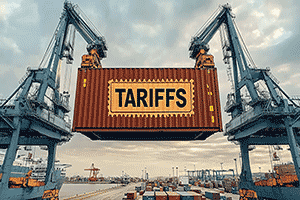
Tariffs Leave CalChamber Members Wary, Bracing for Impact in 2026
By Susanne T. Stirling, Senior Vice President, California Chamber of Commerce


2025 Washington State Election Round-Up – The Pendulum Swings….Again
By Jordan Royer, Vice President External Affairs, Pacific Merchant Shipping Association


Port Indirect Source Rule Newsletter #16
Southern California’s business, labor, and community leaders are uniting behind the Ports of Los Angeles and Long Beach’s Cooperative Agreement with SCAQMD. This balanced, results-driven plan builds on decades of clean air progress and collaboration. Join us on November 7 to show your support for a cleaner, competitive future for our ports and communities.

Restoring Regional Cooperation: A Model for Clean-Air Governance in California
By Thomas Jelenić, Vice President, Pacific Merchant Shipping Association
This article explores the renewed collaboration between the ports, industry, labor and regulators in Southern California — proving that when stakeholders unite behind clear infrastructure and emissions frameworks, shared goals like decarbonization and cargo growth become achievable. Join us in supporting this balanced future.
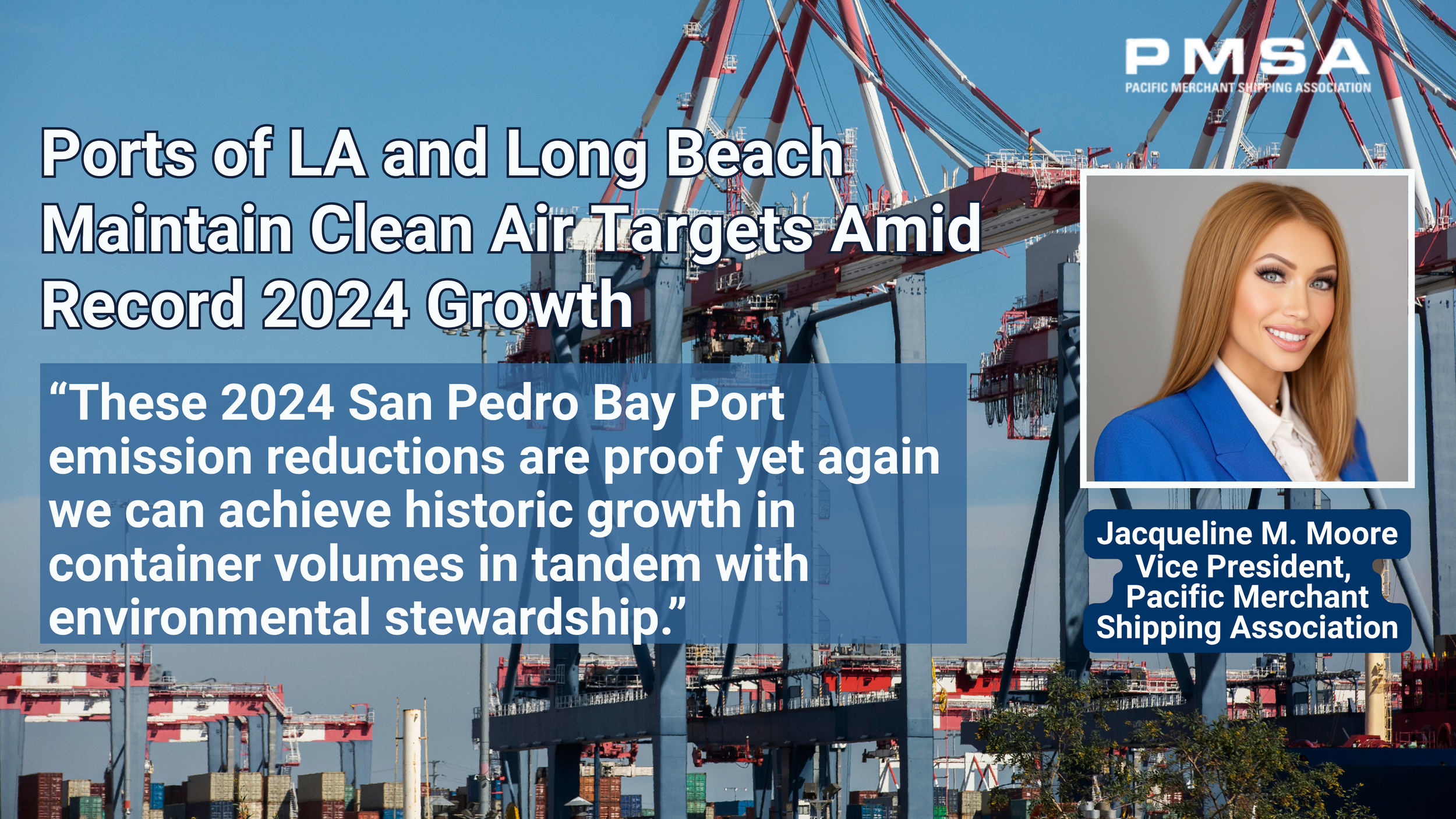
Ports of LA and Long Beach Maintain Clean Air Targets Amid 2024 Growth
By Jacqueline M. Moore, Vice President, Pacific Merchant Shipping Association
In 2024, the San Pedro Bay port complex achieved historic cargo growth while sustaining ambitious air quality targets under the Clean Air Action Plan. Diesel particulate matter, nitrogen oxides, and sulfur oxides all remain far below 2005 baselines, even as throughput surges. Discover how ports can expand and decarbonize together.

September 2025 Report on Containerized Trade at North American Seaports
In September 2025, the Ports of Los Angeles and Long Beach saw declines in container volumes year-over-year, but still posted gains compared to 2019. Other major U.S. and Canadian seaports showed divergent trends. Explore full port comparisons and regional performance in this latest analysis.

Preliminary August 2025 TEUs
In August 2025, San Pedro Bay ports handled 944,832 inbound loaded TEUs, a 2.2% decrease from the previous year but a 24.3% increase from 2019.

Black Swans and Container Forecasts
By Jock O’Connell, Economist
Black swan events—unpredictable, high-impact disruptions such as strikes, cyberattacks, and maritime crises—are reshaping container shipping and global supply chains. Learn how ports, shippers, and logistics operators are adapting forecasts and strategies to build resilience against these rare but costly events.

The Warehouse ISR Experiment: High Costs, No Gains – Why California Must Avoid Indirect Source Rule Expansion
By Tim Jemal, CEO, Supply Chain Federation
A Ramboll study commissioned by the Supply Chain Federation finds California’s Warehouse ISR adds high costs with no emission gains—threatening jobs & supply chains.

Preliminary July 2025 TEUs
July 2025 TEU report: LA and Long Beach hit record volumes while Oakland and Vancouver surge. Explore U.S., Canada & Mexico port trends.

Local Primary in Seattle Provides Shock and Awe Moment for Moderate Incumbents
Jordan Royer, Vice President of PMSA
Seattle’s August 2025 primary delivers shocking losses for moderate incumbents, raising questions about progressive momentum and national political shifts.

The China Trade
USWC ports see steep drop in China trade—imports down over 25% and exports off more than 65% since pre-COVID levels.

Trucking a Container in California Can Cost 35% More Per Gallon of Diesel Than in Houston
California truckers face record diesel prices, paying 35% more than Houston and far above East Coast and Gulf Coast averages. Diesel for drayage in California tops $5/gal, driving up trucking costs at LA, Long Beach, and Oakland ports.

That Big Box on the Road
The story behind 53-foot containers on U.S. highways—how the 1982 STAA law and Rep. Glenn Anderson changed trucking forever.